

What is Positive Behaviour Support (PBS)?
Under every behaviour that challenges is an unheard-expressed need, desire, or concern. Originating in the 1980s from Applied Behaviour Analysis (ABA), PBS has evolved to have a stronger emphasis on being person- or family-centred, distinguishing it from ABA, which is more rooted in learning theory. Through its person-centred framework, Positive Behaviour Support seeks to understand people as individuals and aims to understand their needs, desires and concerns through their behaviour.
PBS recognises that people experiencing behaviours that challenge are vulnerable to:
- Restrictive practices
- Reduced opportunity for relationships
- Reduced inclusion in their community
Behaviour occurs where there is an unmet need, discomfort, or challenges in understanding and navigating the environment. Everyone deserves to be seen, understood, and cared for; therefore, the goal of PBS is not limited to removing or reducing challenging behaviours, and it centres on understanding behaviour and creating capable environments that support people’s needs and aspirations. We provide the right support and understanding to people needing care, families, and friends so everyone can live the fulfilled, meaningful life they deserve. PBS comprehends the power of learning new skills and aims to help people needing support develop skills to improve their quality of life.
PBS empowers all involved to adopt more efficient and positive ways to fulfil individual needs. We recognise that PBS works best when its systems and values are embedded throughout an organisation that uses teamwork and collaboration.
Supporting Choice Through Personalised PBS Strategies
One key aspect of Positive Behaviour Support is its focus on proactive strategies. Instead of waiting for the behaviours of concern to occur and then reacting to them, Positive Behaviour Support encourages PBS specialists and clinicians to anticipate and prevent them by creating supportive environments and teaching alternative skills. This proactive approach helps minimise reactive strategies, such as restrictive interventions, which can have negative consequences, and prioritises Positive Behaviour Support strategies.
Leaf Complex Care has an in-house therapy team of PBS specialists and PROACT-SCIPr-UK® instructors, who provide cost-free services for the people we serve. Our PBS practitioners help each person achieve the best possible outcomes by working proactively with them. It’s about providing them with options and choices when it comes to meeting their social preferences and health needs. Our team meets each person’s needs using a support model and personalised positive behaviour strategies tailored to their needs.
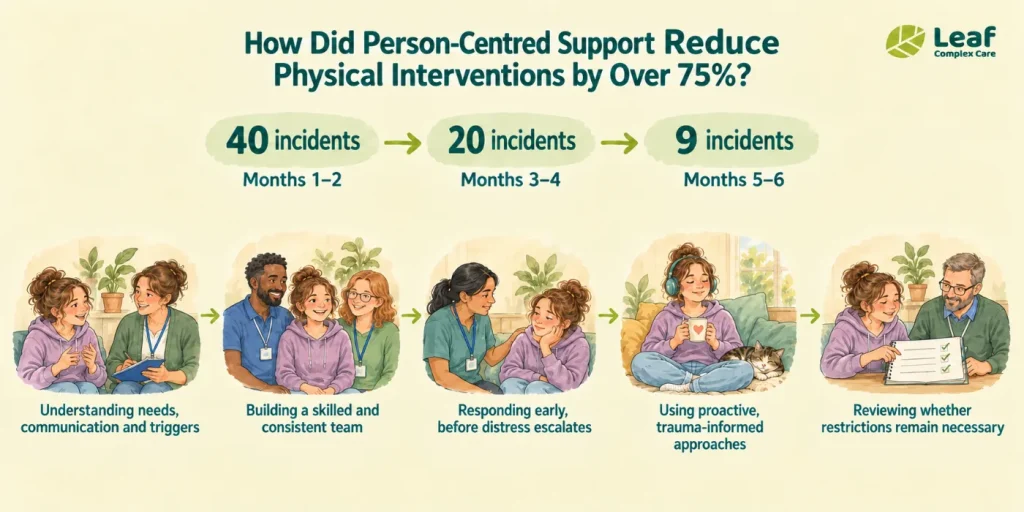
By questioning each restriction, we reduced physical interventions by 75% in only 6 months. From 40 incidents in the first two months, we reduced them to 20 over the next two months, and to 9 in the last two months. How did we achieve it?
What are the Values of PBS?
Positive Behaviour Support is a person-centred approach based on inclusion, participation and choice, designed to improve the quality of a person’s life.
The four core aims of PBS are:
- Increase the quality of life of the person supported
- Increase the skill and resilience of those supporting the person
- Minimise challenging behaviours
- Reduce restrictions on the person supported
What are the Behaviours of Concern?
Behaviours of concern refer to intense and frequent behaviour that harms the individual or anyone else mentally or physically.
Below is a list of common behaviours that challenge:
- Verbal behaviour – shouting, screaming, arguing, name-calling, offensive language
- Nonverbal behaviour – clenching fists, invading someone’s personal space, pointing fingers, stamping, running away
- Withdrawn behaviour – Isolating oneself from their community and support system, deliberate silence
- Hurting others – hitting, head-butting, pinching, biting, scratching, kicking, grabbing
- Self-injurious behaviour – undereating and overeating, pinching, biting, scratching, hair pulling, eye poking
- Destructive behaviour – throwing objects, breaking items
When a specific behaviour of concern is met with empathy and understanding, seeking to understand the underlying reasons or triggers for these behaviours, positive outcomes and desired behaviours begin to arise. Positive Behaviour Support focuses on prevention, teaching alternative skills, and creating supportive environments to reduce the occurrence of these behaviours and improve the individual’s quality of life. Through a PBS framework, challenging behaviours can be reduced or eliminated over time, guided by compassion and care.
What Does a PBS Approach Involve?
The overall aim of the Positive Behaviour Support approach is to provide person-centred support and a framework to improve the quality of a person’s life. It is collaborative and inclusive of all people we support and those supporting them. A PBS approach recognises that the behaviour, not the person, is the problem and avoids blame, punishment, and stigmatising attitudes.
Once a positive behaviour support plan is in place, care professionals supporting the person understand the person’s unique interests, skills and abilities. Under a PBS approach, the support team and PBS practicioners will respond compassionately and calmly when the person displays behaviours that challenge. They will understand how to support the person to communicate, have fun and engage in activities. This way, the person can learn how to meet their needs without using challenging behaviour.
A PBS approach adapts the environment to meet a person’s needs, support them, and improve their quality of life. It is personalised and reflects the person’s interests, helping them live a fulfilling life. For example,
- If playing outside is a critical factor in a person’s life, a simple but effective environmental adaptation is to provide them with a trampoline or swing.
- Or, if the people we support have any sensory needs, we can accommodate low lighting, calm spaces or robust furniture
There will be a clear structure and routine based on the person’s interests, including time to relax, pursue their interests, and learn new skills. This is communicated clearly to the person, and they can have choice and control.
Key Principles of PBS
At its core, Positive Behaviour Support is built on fundamental behavioural principles, including:
- Person-centred care
- Positive reinforcement
- Assessment-Based interventions
- Prevention instead of reaction, and
- Outcome-based approach
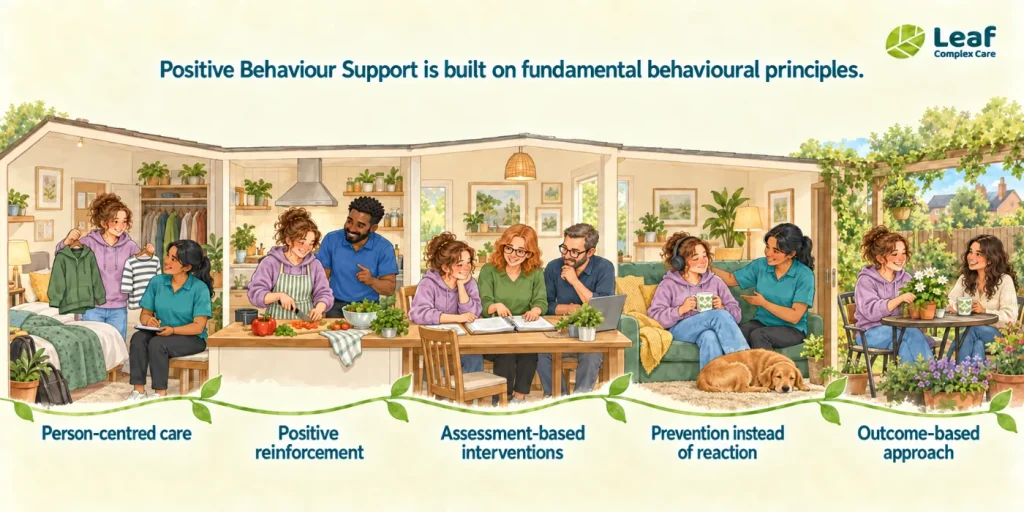
These principles emphasise the importance of understanding the individual’s unique needs, reinforcing positive behaviours, collaborating with stakeholders, conducting thorough assessments, implementing proactive strategies, and focusing on outcomes that will enhance the person’s independence and community living.
To explore each principle more thoroughly, click here.
PBS Behaviour Model Stages
Positive Behaviour Support model stages provide guidelines and frameworks for implementing a person-centred approach to support. PBS model stages aim to increase the overall quality of life, independence, and support of the person. It also maximises the highest success rate possible by providing step-by-step advice. The PBS model stages have three aspects: assess, manage and prevent.
Assess Stage
The assessment stage has three aims that need to be identified:
- The individual’s strengths, important life aspects, and their support systems.
- The individual’s needs and preferences.
- The triggers that lead to the challenging behaviour and the reasons behind it.
Gathering information about the person’s profile allows the care team to get a complete picture of their health needs and capabilities. Additionally, this phase reviews the measurable details of behavioural data. It conducts a Functional Behaviour Analysis (FBA) to better understand, describe, and illustrate the consequences of the behaviour of concern, and to identify the contexts and triggers. The final step is to determine the function or purpose the behaviour served.
Manage Stage
The manage stage describes how to respond effectively to behaviours that occur before and after challenging behaviour. Responding properly helps you safely prevent, redirect, and de-escalate the behavioural challenge with minimal challenge.
The manage stage follows:
- The Escalation Stage
- The Escalation Profile
- The De-escalation Plan
Prevention Stage
The aims of the last model stage, prevention, seek to stop or minimise behaviours that challenge by preventing potential triggers. This stage also focuses on creating a supportive environment tailored to the individual’s needs, teaching alternative behaviours, and enhancing their overall quality of life.
The plan outlines strategies to reduce or prevent triggers that lead to challenging behaviours by offering the individual:
- A supportive and safe environment by tailoring environmental factors to minimise the risk of trigger points
- Activities that support people’s abilities
- Supportive communication and interaction
- A positive way of teaching how to manage the person’s emotions and behaviours
What is a Positive Behaviour Support Plan or PBS Plan?
A Positive Behaviour Support plan is a structured and individualised plan designed to address challenging behaviours experienced by autistic people, people with a learning disability, dementia, or developmental delays. A Positive Behaviour Support plan, or PBS plan, is developed with the person requiring support, their family, support staff and professionals. This process is led by a Positive Behaviour Support practitioner based on understanding why these behaviours are displayed.
The plan will describe the agreed strategies developed with the circle of support and the person. PBS plans should be easy to understand and provide support guidelines. A PBS plan identifies behaviours of concern. It also identifies the impact on the quality of life for the person and those around them. It will clearly explain why the challenging behaviour happens and what needs it meets for the person. It is important to remember that all behaviours that challenge have a purpose. When the root cause is understood, the individual can receive support and meet their needs through healthy, compassionate methods.
The PBS plan will have multiple elements and be split into proactive and reactive strategies. Success comes through implementation, with the plan regularly updated and reviewed to meet individual needs. Progress is measured through accurate data on behaviour patterns, identified goals and quality of life.
Understanding Challenging Behaviour
Challenging behaviours are ways a person has learnt to get their needs met. People with learning disabilities, autism or mental health conditions are more vulnerable to behaviours that challenge, and can significantly impact the quality of a person’s life. Both children, young people and adults can exhibit behaviours that challenge, and they all deserve access to the right support to improve their quality of life. The type of behaviour exhibited will differ between children, young people and adults. PBS provides a customised framework so everyone can get the equal and diverse support they deserve.
We are careful when identifying behaviours as challenging to ensure people are not stigmatised for ways of expressing themselves or normal responses to stress and pain. We recognise that we all have behaviours that challenge and rely on the support, tolerance and compassion of those around us. Some behaviours are more challenging as they significantly impact the quality of life or have a clear risk of harm to the individual or their support system. The people we support are no different and deserve the same support, tolerance and compassion. PBS helps people in need build a fulfilling life and supports family and friends by teaching PBS principles to help them connect better with their loved ones.
Reasons for Challenging Behaviour
PBS implicitly recognises that behaviours that challenge are not a problem within the individual. It is a response learned through interaction with their environment and how the behaviour makes them feel. Everyone experiences difficult behaviours. It is not exclusive to those with a learning disability, mental health conditions and autism. The difference is that neurotypical people are usually equipped with the tools to communicate, express and alter these behaviours.
Antecedents
Every behaviour has an underlying reason linked to something that occurred before the behaviour (antecedents).
- The first type of antecedent is a setting event. This can be related to health problems, changes to routines, emotional states, or places.
- The second type of antecedent is called a trigger. These occur before the challenging behaviour and are usually a direct cause, e.g., hearing a loud noise, seeing a bright light, or feeling pain.
Consequences
After behaviours that challenge, there are always consequences. It is not always apparent that these consequences can negatively impact someone or that they are not effectively supporting them.
Common examples of consequences are:
- How people react (e.g., angry, upset)
- Having something taken
- A change of feeling
Positive Behaviour Support analyses people’s unique behaviours to understand why they exhibit challenging behaviours and what causes them, and offers PBS-friendly alternatives through an easy-to-understand framework.
We can see broader solutions by removing the blame from the person and recognising their needs. Under a PBS approach, we do not reduce behaviours that challenge because it is difficult. We reduce behaviours that challenge because we want to enhance the person’s quality of life and enable them to live fully.viours that challenge because we want to enhance the person’s quality of life and enable them to live fully.
Positive Behaviour Support Planning
Positive Behaviour Support is split into proactive and reactive strategies to understand the root cause of a behaviour and improve a person’s quality of life. Proactive strategies improve the quality of a person’s life in the long term, requiring time, compassion and patience from support teams. Proactive strategies address the person’s need to display the behaviour and impact on quality of life. Strategies here may include:
- Teaching skills
- Managing triggers
- Improving health
- Developing relationships
- Reward systems
Reactive strategies end the episode of challenging behaviour as quickly and safely as possible.
Offering preferred activities or items, distracting or just ending a difficult activity are reactive strategies. Where possible, restrictive practices are avoided, and their use minimised. Reactive and proactive PBS strategies need to be combined to improve the quality of a person’s life and provide the right support for a person.
We have implemented Positive Behaviour Support Plans that focus on the capabilities of the people we serve. Richard’s care journey with Leaf Complex Care is based on trust and a genuine commitment to building Richard’s strengths together. We created a safe environment that supports him through his challenges and built strategies to support positive behaviours.
Please hear what Richard’s parents have to say about our journey together.,
Leaf Complex Care Applies PBS within Tailored Person Centred Care
At Leaf Complex Care, we aim to support and serve those needing quality care. Our mission is to provide expert, compassionate service dedicated to serving those in need. We understand the value of Positive Behaviour Support and witness the difference that PBS has on people’s lives daily.
Our care teams are trained in PRO-ACT SCIPr, a ‘whole approach’ to supporting people with or at risk of displaying behaviours that challenge. This individualised approach focuses on proactive steps to reduce the need for reactive strategies.
Our positive behaviour support team can provide a range of services to people we support, their families and support staff. These include:
- Functional assessment of challenging behaviours
- Development of evidence-based support strategies
- Personalised training for teams supporting individuals
- Development of positive behaviour support plans
- Multi-disciplinary working in complex situations
- Debriefing and emotional support for our support workers
- Ongoing monitoring and reduction in the use of restrictive and institutional practice
Whether you want to learn more about Positive Behaviour Support or discover how we can help you, please get in touch with our team at Leaf Complex Care, who are ready to guide you, or your loved one, to your next care journey. at Leaf Complex Care, who are ready to guide you, or your loved one, to your next healing journey.
You can find us in Bristol, the South East, and Somerset, while we deliver care across the UK.