

What Is Post-Discharge Support?
Post-discharge support is the planned and ongoing support, care, rehabilitation, housing, practical and emotional care that takes place once the person leaves inpatient care, for example after a hospital admission, mental health inpatient stay, community hospital stay, or rehabilitation ward. Through this type of support, people can leave the hospital safely, recover at home, or in another appropriate setting, reduce avoidable readmissions, and regain as much independence as possible.
In practice, post-hospital discharge care can include:
- Short-term recovery support services at home (intermediate care, reablement, rehabilitation, or recovery support services). It is usually aimed at helping someone regain independence after illness, injury, surgery or a fall.
- A discharge plan and practical arrangements.
- Discharge to Assess/Home First. Discharge policy often uses a “Home First” approach, where people who are medically ready leave the hospital as soon as it is safe, and longer-term care needs are assessed after discharge in a more realistic setting.
- Equipment, adaptations and therapy. Support may include mobility aids, a hospital bed, a commode, a hoist, grab rails, telecare, fall prevention, medication support, physiotherapy, occupational therapy, and a home safety assessment.
- Carer involvement and carer assessment.
- Longer-term care assessment.
At its best, post-discharge support is personal. It asks, “What matters to this person?” What makes them feel safe? What does a good day look like? Who do they trust? What risks need to be understood rather than simply managed? What environment will help them thrive?
The Transition from Hospital to Home
Leaving the hospital is often spoken about as a discharge date, a pathway, or a handover. But for the person at the centre of it, it is much more than that.
It can be the first night sleeping somewhere new. The first morning without the familiar rhythm of the ward. The first time making a cup of tea in a home meant to feel safe but not yet familiar. For families and carers, it can bring relief, hope, anxiety and uncertainty all at once. For professionals, it is the point where planning becomes real, where the quality of relationships, preparation, and continuity can determine whether someone is able not only to leave the hospital but also to stay well beyond it.

As a carefully developed and supported journey from inpatient care into community life. When done well, it helps people recover, rebuild confidence, regain independence, and reconnect with the people, routines, and places that matter to them. When done poorly, it can feel rushed, fragmented, and frightening, increasing the risk of crisis, readmission, or a return to restrictive settings. For people with multiple needs requiring complex care, long inpatient stays, trauma histories, mental health needs, learning disabilities, autism, behaviours of concern, or previous breakdowns in support, this transition can be especially delicate. The move home must be relational, planned and paced. It requires people who can stay close during uncertainty, build trust before discharge, respond to risk in real time and work alongside the wider system rather than outside it.
Read more about Moving People in High-Risk Situations from Hospitals to Home.
Who Needs Post-Discharge Support?
Post-discharge support is needed by people whose recovery does not end at the hospital door. For some, leaving hospital is a welcome return to familiar surroundings. For others, it can feel uncertain and overwhelming. A person may be medically ready to leave the ward but still need support to walk safely, manage medication, rebuild confidence, reconnect with family, or adjust to a new home, care team, or routine.
In this sense, post-discharge support is not only for people with the highest level of need. It is for anyone whose transition from hospital to home, or from hospital into another community setting, requires planning, coordination and care, including:
- People with a learning disability and autism
- People with mental health needs
- People with social care needs
- People with new or increased care needs
- People recovering after illness, injury or surgery
- People who have been in hospital for a long time
- People without suitable housing or a safe home environment
- People at risk of readmission
What Effective Post-Discharge Support Should Include
The significant life transition of leaving the hospital can involve clinical risk, emotional uncertainty, trauma, changes in routine, new relationships, unfamiliar environments and the challenge of rebuilding everyday life outside an inpatient setting. Therefore, for the person to feel safe and supported before, during, and after the move, health professionals must create the conditions, bring in the right people and the right environment, and plan together. That way, the transition becomes much safer and sustainable, not only on paper but in real life.
Person-Centred Transition Planning
The right support starts with the person. A person-centred transition plan should be built around who the person is, what matters to them, what makes them feel safe, and what kind of life they want to move towards. It should include their communication needs, relationships, routines, sensory preferences, cultural needs, risks, strengths, triggers, hopes and long-term goals.
The personalised support and planning should begin early, ideally while the person is still on the ward. For people with multiple needs, waiting until the point of discharge is often too late. The person needs time to build trust with new staff, visit or understand their future home, prepare emotionally for change, and experience consistency between hospital and community teams.
A strong transition plan usually includes:
- The person’s own views, wishes, and preferences
- Family, carer or advocate involvement where appropriate
- Clear clinical, social care, housing and community input
- Positive Behavioural Support services, where relevant
- Risk planning that is proactive rather than restrictive
- A plan for medication, physical health, mental health and crisis response
- Clarity about who is responsible for each part of the transition
- A realistic timeline that reflects the person’s pace, not just system pressures
Emotional and Mental Health Support
For people who have spent a long time in hospital, the outside world can feel overwhelming. For people with trauma histories, autism, learning disabilities or mental health needs, sudden change can increase anxiety, distress or behaviours of concern. That’s why emotional and mental health support should become a core part of hospital discharge planning.
In practice, emotional support often comes through relationships. People need to feel that those around them understand their history, distress, communication, and ways of coping. This is especially important where someone has experienced long-term institutional care, seclusion, restraint, failed placements or repeated admissions.
This may include:
- Emotional preparation before the move
- Trauma-informed support
- Anxiety management and reassurance
- Consistent relationships with trusted staff
- Crisis planning and relapse prevention
- Access to community mental health support
- Support to rebuild confidence and identity
- Time to adjust to new routines and environments
- Family or carer support where appropriate
Continuity of Care
Continuity is one of the most important parts of safe discharge. Too often, people experience a cliff edge between hospital and community support. One team steps away before another has fully understood the person. Important information is lost. Relationships are broken. New staff are expected to manage risk without the knowledge, confidence or training they need.
Continuity of care means that information, relationships and support carry through the transition. The person should not have to start again with every new professional. The community team should understand what has been learned in hospital care, and hospital staff should remain connected long enough to support a safe handover.
Continuity should include:
- Early involvement of the future support team
- Shared planning between the hospital, commissioners, social care providers, healthcare providers, and clinicians.
- Clear communication about risks, ongoing health and social needs, health advice, practical support, ongoing rehabilitation, smooth transition, support recovery, post-discharge care and support strategies.
- Staff shadowing and joint work before dicharge
- Timely sharing of assessments, PBS plans, medication plans and crisis plans
- A named person or team coordinating the transition
- Consistent routines and communication approaches
- Follow up after the move, not just before it
Daily Living Support
Daily living support may be the difference between a placement that survives and a life that begins to feel meaningful. The supported person may need help with personal care, meals, medication, mobility, communication, budgeting, appointments, relationships, community access, household routines or developing confidence in their own home or new environment.
Daily living support is not only task-based additional support but also helps the person to rebuild ordinary rhythms and increase independence where possible. It should support choice, dignity, comfort, and participation in community life. For people with multiple needs in complex situations, the environment itself also matters. The right home, location, sensory environment, staffing model and community connections can all affect whether the person feels safe and settled.
The Importance of Early Discharge Planning
As we have already mentioned, the journey to leave hospital should never begin on the day of hospital discharge. It needs to begin much earlier, through careful conversations, trust-building and shared planning between multidisciplinary teams, the person, and their family members. When hospital care has been part of someone’s life for a long time, moving back into a familiar setting, or into a new home that can become familiar, can bring hope, but also fear and uncertainty. Early planning gives everyone time to understand what matters to the person, what ongoing care will be needed, and what must be in place for them to be discharged safely.
A list of services alone cannot form a strong care plan. Early discharge planning should signal that the person will not be left to manage the next chapter alone. Doctors, nurses, therapists, social workers, commissioners, providers and families all have a role in shaping hospital discharge care that feels safe, personal and realistic. When people are listened to early, when family members are included with compassion, and when personalised care is built around the person before they leave hospital, discharge becomes less of a sudden ending and more of a supported beginning.
Community-Based Support Services After Discharge
Leaving hospital is only the beginning of recovery. The right community-based support can make the difference between a discharge that feels uncertain and a transition that feels safe, stable and hopeful. These services help people settle into home or supported living, rebuild confidence, manage ongoing care needs and stay connected to the people, routines and communities that matter to them.
Rapid Response and Crisis Teams
Rapid response and crisis teams provide immediate support when someone’s situation begins to feel unstable after discharge. For people with complex care needs, the early days at home or in a new setting can bring moments of distress, uncertainty or increased risk, especially when routines, relationships and environments are still new. Teams can help prevent a crisis from becoming a readmission by responding quickly, offering adjusting support, coordinating with carers and providers, and helping the person feel safe where they are. Where needed, this response should be trauma-informed, recognising that distress may be linked to past experiences of hospital care, restrictive settings or previous breakdowns in support.
‘’As PBS Practitioners, our job is to ensure our approach is trauma-informed, to align the Positive Behaviour Support (PBS) approach with the ‘Trauma Recovery Model’ being implemented. One example of how a trauma-informed approach can be seen in practice is in the way our support staff have changed the way they write their daily records. When care teams write records about a child, the child has the right to read those records.In a trauma-informed approach, there is feedback from young adults who were previously children in care that reading these records after leaving care can be traumatising in itself. It is important, therefore, that staff are trained to write in a way that the child can understand, with the aim of avoiding them feeling re-traumatised when they later read it.” – says our Restrictive Practice Lead, George Rickard
Read more about her expertise in Trauma-Informed Practice: The Stories We Write About People and How They Shape Their Recovery.
Autism and Mental Health Support
Autism and mental health support after discharge should be built around understanding, not simply managing, the person’s needs. Autism-informed care means recognising communication preferences, sensory needs, routines, predictability, processing time and the impact of change. While mental health support may include community mental health teams, therapy, medication support, crisis planning, emotional regulation strategies and help rebuilding confidence after hospital care. The aim is to help the person feel understood, respected and emotionally safe as they settle into life beyond hospital.
At Leaf Complex Care, we are proud to hold Autism Accreditation in Somerset and the Midlands, including the Autism Accreditation Specialist Certificate. This achievement reflects our continued commitment to providing autism-informed, person-centred support that recognises each person’s strengths, respects their needs, and places their wellbeing at the heart of everything we do.
Supported Living
Supported living can provide a home-based alternative to hospital or residential care, offering people their own space with the right level of support around them. For people who require complex care, the quality of housing matters as much as the support itself. The home must be safe, accessible and suited to the person’s sensory, emotional, physical and social needs. Support should be person-centred, helping with daily routines, relationships, community access, medication, appointments and independence, while still respecting choice and privacy. When supported living is planned well, it gives people the chance not only to leave hospital, but to begin building a life that feels familiar, stable and their own.
Intermediate Care and Short-Term Reablement
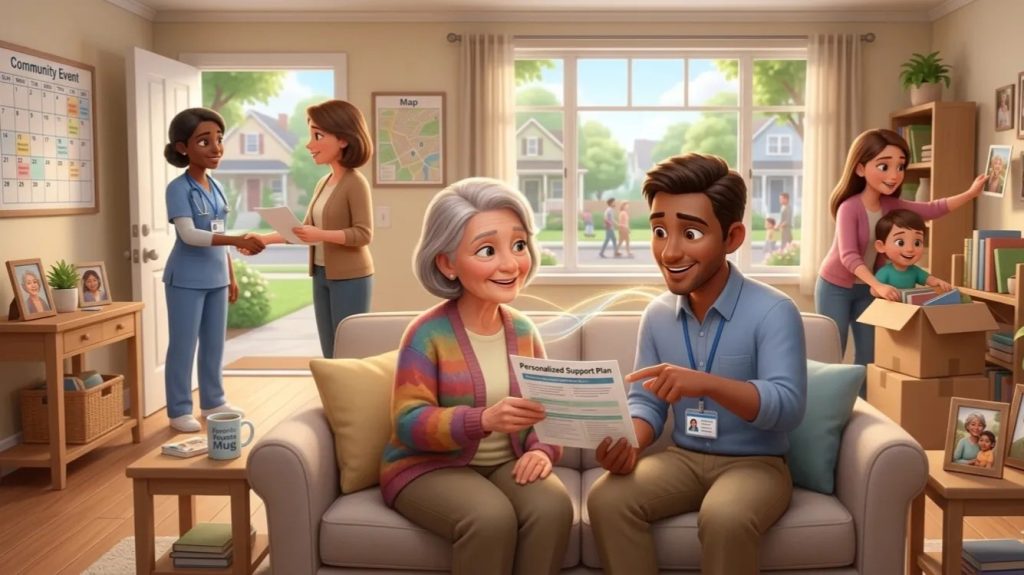
Intermediate care and short-term reablement help people regain skills, confidence and independence after leaving hospital. This support is usually time-limited and may include help from occupational therapists, physiotherapists, nurses, care workers or reablement teams. Reablement, as part of the recovery process, should be paced carefully, recognising that progress may be emotional as well as physical. It might involve relearning routines, building confidence at home, practising daily living tasks, managing anxiety, and adjusting to a new environment. When delivered with patience and compassion, short-term reablement can help people move from simply being discharged to genuinely feeling able to live more independently.
Long-Term Care and Complex Care Services
Some people need longer-term or specialist support after discharge because their needs cannot be met through short-term services alone. Long-term care and complex care services may include specialist support teams, Positive Behavioural Support, nursing input, mental health support, autism-informed care, trauma-informed approaches, personal care, community access and ongoing housing support. For people with high levels of risk or long histories of inpatient care, this support must be consistent, skilled and relational. The goal is not just to maintain a placement, but to help the person experience safety, dignity, choice and belonging in the community over time.
Risks of Inadequate Post-Discharge Support
When post-discharge support is not planned well, the move from hospital to home can quickly become unsafe, overwhelming or unsustainable. A person may be clinically ready to leave hospital, but without the right care plan, housing, relationships and ongoing care in place, they can feel abandoned at the very point they most need reassurance. Inadequate support can also lead to fragmented care. Hospital teams may step away before community teams are fully prepared, leaving gaps in communication, risk planning and daily support. Families may be expected to manage more than they are able to, while providers may not have enough information, training or time to build trust with the person. When the transition feels rushed or poorly coordinated, the person may struggle to settle, and the opportunity to rebuild confidence in a familiar setting or new home can be lost.
For people with autism, mental health needs, trauma histories, or long inpatient stays, poor discharge planning can be especially harmful. Sudden changes, unfamiliar environments, unsuitable housing or inconsistent support can trigger distress and make the person feel unsafe. Without autism-informed care, trauma-informed care and relational continuity, the move into the community may feel less like a new beginning and more like another disruption.
The risks of inadequate post-discharge support include:
- Hospital readmissions
- Placement breakdowns
- Crisis escalation
- Mental health deterioration
The Role of Specialist Community Transition Providers
For people who have spent long periods in inpatient care, or whose needs involve autism, mental health, behaviours of concern, trauma, housing challenges or high levels of risk, discharge cannot be treated as a single event. It must be a carefully held process, shaped by relationships, trust, preparation and continuity. At Leaf Complex Care, our care bridges the gap between hospital and home by creating the right conditions for people to come home and stay home.
Bridging the Gap Between Hospital and Home
At Leaf Complex Care, we believe that supporting someone to leave hospital is not simply about arranging a discharge date. It is about bringing together health, social care, housing and community support in a way that works around the person, not the system. Our role is to bridge the gap between hospital and home by starting support early, staying close during the transition, and making sure the person is not left to face change alone.
This means understanding what matters to the person, what their vision of a good life looks like, and how support should be shaped around them. Through a coordinated pathway, we work alongside hospital teams, commissioners, providers and families to help people move safely into homes and communities where they can begin to rebuild confidence, routine and belonging.
Intensive Support for Complex Needs
For people who require complex care support, the transition from hospital to home often requires intensive, skilled, and relational support. We provide:
- Structured support that begins before hospital discharge, continues through the move, and remains in place while the person stabilises in the community.
- Working as part of the person’s wider support team
- Shaping housing options
- Upskilling teams in real time so that risk is understood and responded to safely.
Our approach recognises that complex transitions can be fragile. People may need autism-informed care, trauma-informed care, Positive Behavioural Support, carefully matched staff, and a team that can respond calmly and consistently when situations feel uncertain. The aim is not only to manage risk but also to build trust, reduce distress, and create the foundations for long-term stability.
Preventing Out-of-Area Placements
When suitable support or housing is not available locally, people can remain in hospital longer than needed or be moved into out-of-area placements that do not reflect who they are or where they belong. At the heart of our mission is helping prevent people from being placed far from their families, communities and familiar networks.
We prevent this by working with partners to shape support and housing around the person, creating environments where people can lead meaningful lives closer to home or in their own homes. By bringing together commissioners, clinical teams, providers, and housing and community support, we help build local solutions to address complex needs. This supports safer discharge, reduces the risk of readmission, and gives people a better chance of remaining connected to the places, people, and routines that matter to them.
Leaf Complex Care and Post-Discharge Support
At Leaf Complex Care, we bridge the gap between hospital and home through our four-phase Bridging Support model: Ward, In-Reach, Transition, and Discharge and Stabilisation. We start early, work alongside clinical teams and commissioners, shape the right support around the person, and stay close through the move so people can leave hospital safely and settle with confidence.
Ready to create safer, more sustainable discharges? Partner with Leaf Complex Care and let’s work together.
Offices: Bristol, the South East, the Midlands and Somerset.
