


The Modern Approach of a Complex Care MDT
What was once considered primarily, the management of risk, behaviours, care tasks or discharge should now be understood as something much broader. Modern multidisciplinary working is rights-based, person-centred, trauma-informed, and community-connected, supporting people to experience meaningful lives with choice, dignity, relationships, independence and genuine community participation.
From a Positive Behaviour Support perspective, this also means moving away from seeing behaviour as a problem located within the person. Instead, behaviour is understood in the context of communication, health, relationships, sensory needs, previous experiences, environmental demands, predictability, opportunities for choice and the quality of support being provided. – Darren Moyle, PBS Practitioner.
The person is therefore never reduced to “a placement”, “a package”, “a risk profile” or “a behaviour presentation”.
From a PBS perspective, integrated care should result in one shared understanding of what a good life looks like for the person and what the MDT must change, provide or develop to help make that possible. Success should therefore be judged not simply by reduced incidents, admission avoidance or service stability, but by whether the person has increased choice, meaningful activity, relationships, communication, independence, participation and access to ordinary community life.
The modern MDT is broad. In one sentence, it brings together health and social care, therapy, housing, and family knowledge. This approach:
- Uses Positive Behaviour Support as a whole-system, proactive framework focused on quality of life, prevention and skills development rather than simply responding to incidents.
- Uses functional assessment and formulation to understand why distress or behaviours of concern occur and what environmental, interpersonal, communication or support factors may be maintaining them.
- Actively reduces reliance on restrictive practices, unnecessary medication and crisis-led responses through proactive support and least-restrictive alternatives.
- Builds capable environments in which staff understand the person, communicate effectively, provide meaningful choice and support predictable, active and fulfilling lives.
- Uses data and regular review to establish whether support is improving quality of life as well as reducing the frequency, intensity or impact of behaviours of concern.
- Prioritises sustainable community support and admission avoidance wherever this can be achieved safely and in the person’s best interests.
- The Holistic Model of Occupational Therapy – co-produced with Ophelia Xerri, Occupational Therapist
- How Multimedia Is Transforming Support for People with Learning Disabilities and Autism – an interview with Ben Andrew, PBS Coach and Multimedia Specialist.
What drove the growth towards more humanised services?
The growth of humanised complex care has been driven partly by law and statutory guidance. Together, these frameworks pushed services away from “doing to” people and towards participation, rights, reasonable adjustments, least restriction and person-centred planning. The move towards more humanised MDT practice was also driven by repeated failures in institutional and inpatient settings, including Winterbourne View, Whorlton Hall and Cawston Park. These incidents made it impossible to ignore the danger of closed cultures, poor oversight, restrictive practice, over-medication, weak safeguarding and lack of family involvement. As historical references to what care is not, they directly shaped expectations for modern MDTs to be more transparent, family-inclusive, trauma-aware, rights-based, skilled, accountable, and community-focused.
From a PBS perspective, these failures also demonstrate the dangers of locating difficulty solely within the person. Restrictive environments, inconsistent support, poor communication, limited meaningful activity, lack of choice, under-skilled staff and closed organisational cultures can themselves increase distress and behaviours of concern. Modern PBS therefore asks not only “what is the person doing?” but also “what is happening around the person, what function might the behaviour serve, and what can the system change?”
Despite policy commitments, the shift away from hospital-based care remains incomplete. This is one of the strongest reasons modern complex care MDTs need to be proactive. Through wide experience, we have all learned that good intentions are not enough and that people need skilled community teams, suitable housing, funding alignment, crisis support, therapeutic input and strong oversight. In PBS terms, this means developing capable environments rather than relying solely upon specialist intervention. Frontline teams need to understand the person’s communication, sensory profile, preferences, routines, trauma history (where relevant), early indicators of distress, likely functions of behaviours of concern, and the proactive strategies contained within the person’s support plan. Training alone is insufficient: staff also require coaching, modelling, supervision, reflective practice and feedback so that agreed approaches are reliably translated into everyday support.

Who Makes Up the Core Transition Multidisciplinary Team?
The transition team is a diverse group of care professionals who take on the utmost responsibility for people’s primary health care and are essential in planning, coordinating, and safely supporting someone’s move from hospital, residential care, or crisis placement into the community. The exact team depends on the person’s complex health care needs, but the strongest transition MDTs include both clinical expertise and people who know the person well. Having clear goals and regular meetings that facilitate structured communication in multidisciplinary teams helps MDTs avoid narrow-focused solutions in problem-solving.
But, regularly, the core transition MDT team may include:
- The person being supported, which is the central voice in the process.
- Family members and carers, as they share important history, communication needs, early warning signs, preferences, risks and what helps the person feel safe.
- Transition lead/case coordinator, who keeps the transition plan organised, ensures actions are followed up on, coordinates professionals and prevents gaps between services.
- Commissioner/funding representative, who confirms funding and approves the support model and helps remove health care system barriers that could delay discharge or community placement.
- Social worker/local authority representative, who leads or contributes to care and support planning, safeguarding, Care Act duties, Mental Capacity Act processes and long-term support arrangements.
- Clinical lead/nurse who oversees health needs, medication, risk, clinical training, care planning and safe handover from hospital or previous services.
- Psychologist or PBS practitioner, who contributes to functional assessment and formulation, helping the MDT understand the relationship between the person’s behaviour, communication, physical and emotional wellbeing, environment, relationships, previous experiences and the consequences surrounding behaviour. They support the development of proactive, preventative and skills-building strategies, establish meaningful quality-of-life outcomes, support reduction of restrictive practices, and coach teams to implement PBS consistently in everyday practice.
- Occupational therapist, to assess daily living skills, sensory needs, routines, independence, equipment, environmental adaptations and safe use of the home.
- Speech and language therapist, who supports communication, accessible information, eating and drinking needs, and helps the team understand how the person expresses choice or distress.
- Mental health professional/psychiatrist, who reviews mental health needs, diagnosis, medication, relapse indicators and crisis planning where relevant.
- Support provider/care manager, who designs and manages the day-to-day support model, staffing, rotas, training, supervision and transition readiness.
- Support workers/transition support team, who are critical members of the PBS process because they develop the day-to-day relationships within which good support occurs. They learn the person’s communication, preferences, routines and early signs of distress, implement proactive strategies, support new skills and meaningful engagement, collect relevant information, and provide feedback about what is and is not working.
- Housing provider/accommodation lead to ensure the home is suitable, safe, personalised and ready, including adaptations, tenancy arrangements and environmental planning.
Shared Accountability and Fragmented Care
In complex care, no single professional or organisation can hold the whole picture alone. In England, people with long-term conditions account for around 70% of total health and care spend, alongside a significant proportion of outpatient appointments and inpatient bed days. This does not mean that people who require complex care are the problem. It shows that when responsibility is fragmented, people are more likely to experience delays, repeated assessments, unclear communication, hospital admission, delayed discharge and crisis-led decisions. The real message behind the data is not that people with multiple needs are costly, but that fragmented systems are costly, clinically, financially and humanly.
This is why multidisciplinary working has become central to modern complex care. A collaborative MDT ensures that medical treatments, behavioural strategies and social interventions align by working from one shared understanding of the person, rather than separate professional opinions. This usually starts with a shared formulation that clearly identifies:
- What matters to the person as well as what matters for them
- Their strengths, preferences and aspirations
- Their communication and sensory needs
- What a good day/good life looks like
- Situations associated with wellbeing and successful engagement
- What may increase vulnerability or distress
- The function or purpose behaviours of concern may serve
- Setting events and antecedents
- How staff responses/environmental consequences may unintentionally maintain difficulties
- Skills the person may need support to develop
- Environmental or systemic changes required
- Restrictive practices currently being used
- What outcomes will demonstrate that PBS is working
From there, each professional decision is tested against the same question: Will this improve the person’s quality of life, increase meaningful choice and participation, develop skills and independence, reduce avoidable distress and restriction, and enable the person to live safely within an environment that understands and supports them?
What are Complex Care Transitions?
Complex care transitions are planned moves between services, settings or stages of support for people whose needs are too layered to be managed by one professional, one service or one discharge plan. In UK health and social care, this can include moving from hospital to home, from an inpatient mental health setting to community support, from an emergency department into short-term community care, from a children’s service into adult services, or from a specialist placement into supported living.
ᯓ➤ Hospital-to-community transition is the period around admission and hospital discharge where better coordination between health and social care services is needed to improve people’s experience and outcomes.
In simple terms, a complex care transition is not just a transfer of location. It is a transfer of clinical responsibility, risk planning, communication, medication, therapy input, behavioural support, social care, housing arrangements, family involvement and day-to-day routines. That is why managing care transitions requires more than a discharge date and a coordinated plan that follows the person before, during, and after the move.
From a PBS perspective, transition also involves transferring knowledge about what makes life work for the person: communication, preferred routines, relationships, sensory needs, meaningful activities, coping strategies, early signs of distress, known functions of behaviours of concern, proactive supports and the responses that should be avoided because they may inadvertently escalate or reinforce difficulties.
The Pre-Discharge Phase: Joint Formulation and Risk Mitigation
The pre-discharge phase is where a complex care transition should become clinically clear, shared and risk-informed before the person leaves the hospital or an inpatient setting. Care professionals are consistent on one point: discharge planning should start early, involve the person and their chosen carers, and bring together hospital, community, social care, housing, and other relevant partners around one care plan. In practice, this phase is when the MDT develops a shared understanding of the person’s physical and mental health, communication, behaviour, trauma history, medication, family context, environment, risks, and the support needed after discharge. This prevents transition planning from becoming a last-minute handover and helps ensure that every professional is working from the same picture of the person.
For people whose transitions have previously been associated with behaviours of concern, the MDT should, wherever possible, develop a shared functional understanding before discharge. This should examine not simply what the behaviour looks like, but when and where it occurs, what tends to happen beforehand, what the person may be communicating or attempting to achieve or avoid, what happens afterwards, and which environmental or support factors increase or reduce its likelihood. Crucially, PBS planning should identify both proactive strategies and quality-of-life improvements, rather than relying predominantly upon reactive or crisis strategies. The MDT should ask what needs to change in the environment, communication approach, routines, activity, relationships and level of choice so that behaviours of concern become less necessary for the person.
Risk mitigation in this phase involves identifying foreseeable risks early and putting the right safeguards, relationships, and community supports in place before the move happens. For people with a learning disability and behaviour of concern, it is recommended a joint responsibility for managing risk, with the aim of avoiding unnecessary placement changes or increased restrictions. The MDT should identify setting events, antecedents, early indicators of distress, communication needs, environmental conditions and interaction patterns associated with increased or reduced likelihood of behaviours of concern.
Risk planning should follow the principle of least restriction. Where restrictive interventions remain foreseeable, there should be clear safeguards, defined thresholds, monitoring, post-incident review and an explicit plan for reducing reliance upon them over time.
When done well, the pre-discharge phase turns risk from something held by one service into something understood, planned for and safely shared across the whole transition team.
The Transition Window: Managing Clinical and Continuity Risks
The transition window is the delicate space between leaving the safety and structure of an acute setting and beginning again in the community. It may follow a hospital admission, a stay in an inpatient mental health setting, or even a crisis presentation at the emergency department. For people with complex health needs, it is the moment where everything can either feel held or suddenly become uncertain. For the person, this may mean a new home, a different routine, unfamiliar faces, more freedom and more responsibility. For PBS, this is also a period of heightened vulnerability because familiar cues, relationships, routines and sources of predictability may suddenly change. Behaviour that emerges during transition should not automatically be interpreted as deterioration within the person; it may represent understandable communication of uncertainty, loss of control, sensory overload, unmet need or difficulty adapting to an unfamiliar environment. Continuity of familiar people, communication approaches, routines, preferred activities and proactive PBS strategies should therefore be treated as clinical and behavioural safeguards, not optional extras.
“Positive Behaviour Support is about seeing the person before we see the behaviour. When someone is distressed, their behaviour often tells us something about what they are experiencing, what they need, or what is not working for them. Transitions can be particularly difficult because so much can change at once — familiar people, routines, environments and the sense of knowing what is going to happen next. Our role is not simply to help someone ‘cope’ with those changes, but to listen, understand and adapt the support around them.” – Darren Moyle, PBS Practitioner.
This is where details matter. The transition plan should also identify who will coach the receiving team, how the PBS plan will be implemented from day one, how staff will recognise early indicators of distress, what low-arousal responses should be used, which responses should be avoided, how incidents will be reviewed and what data will be gathered to establish whether the placement is becoming more stable. When this phase is managed well, the transition becomes more than a move between settings. It becomes a carefully supported step towards dignity, continuity and lasting stability in the community.
Environmental and Functional Adaptation: Post-transition Support
Environmental and functional adaptation begins once the person is no longer moving towards transition but is living within it. After discharge or community placement, the MDT’s role shifts from planning the move to understanding how the person is actually experiencing the new environment. This means paying close attention to the home, sensory surroundings, routines, mobility, communication, daily living skills, community access and relationships. What looked right on paper may need adjusting in real life, which is why follow-ups, monitoring, and early intervention are so important in post-transition support.
A core PBS question after transition is therefore whether there is a good fit between the person and their environment. Where distress increases, the first response should not automatically be to increase supervision, restriction or medication. The MDT should consider whether expectations, communication, sensory conditions, staffing approaches, activity levels, predictability, relationships or opportunities for choice need to change.
In the first days and weeks, small signs can tell the MDT whether the transition is settling or beginning to strain. Changes in sleep, appetite, behaviour, medication tolerance, anxiety, engagement, personal care, mobility, or family confidence may all indicate the need for review. Monitoring should capture more than incidents. The MDT should also look for positive indicators of quality of life, such as increased engagement, communication, choice-making, participation in preferred activities, development of relationships, community access, independence, skill acquisition and reduced reliance on restrictive support.
”A fall in incident numbers alone should not automatically be interpreted as success if the person has simultaneously become less active, less communicative, more isolated or more restricted.” – Darren Moyle, PBS Practicioner.
Key Benefits of MDT-Led Transitions
MDT-led transition offers so much more besides professional coordination. It offers a safer, clearer, and more human pathway for people moving between hospital, inpatient care, the emergency department, and primary care support, and between home, supported living, and community-based services. MDT-led transitions are often measured through clinical outcomes, such as fewer crises, incidents or hospital readmissions. While these outcomes matter, they do not show the full impact of a transition on the person’s everyday life. Positive Behaviour Support encourages teams to look further – at whether the person feels understood, has greater choice and is building a meaningful life in the community. As Darren Moyle, our PBS Lead Practitioner, explains:
For me, a successful transition isn’t just about fewer incidents or avoiding a hospital admission. It is about seeing someone begin to feel safe, develop trusting relationships, make meaningful choices, take part in things that matter to them and gradually build a life that feels like their own. That is what good Positive Behaviour Support should ultimately be about.”
Reduced Readmission Rates
A well-coordinated MDT can reduce the likelihood of avoidable readmission by identifying risks before they escalate. When the team understands the person’s complex health needs, support can be adjusted quickly after discharge. This helps prevent the cycle of crisis, emergency department attendance, hospital admission and repeated discharge, replacing reactive care with earlier intervention and better community stability.
PBS contributes to this by shifting the emphasis upstream – from managing crises after they occur to identifying unmet needs, adapting environments, improving communication, strengthening staff practice and increasing the person’s repertoire of skills and coping strategies before crisis develops.
Coordinated Safeguarding and Risk Management
MDT-led transitions also allow safeguarding and risk to be managed collectively, rather than left to a single service or professional. Clinical risks, behaviours of concern and the contexts in which they occur, environmental risks, mental health concerns, family pressures, and social vulnerabilities can be reviewed together to provide the team with a shared understanding of what may place the person at risk and what support reduces that risk.
PBS also requires the MDT to consider risk arising from services themselves, including excessive restriction, inconsistent support, poor communication, unsuitable environments, lack of meaningful activity or responses that unintentionally escalate distress.
Continuity of Care and Medication Management
Continuity is one of the strongest benefits of MDT-led transition planning.
PBS plans should not simply be transferred as documents. The receiving team needs opportunities to observe good support, practise strategies, receive coaching and demonstrate that they understand both what to do and why they are doing it. Where psychotropic medication is associated with the management of behaviours of concern, medication review should sit alongside functional understanding and PBS planning rather than replacing it.
Improved Experience and Satisfaction
For the person and their family, an MDT-led transition can make the process feel less frightening, fragmented and repetitive. Instead of having to explain the same needs to different professionals, they are supported by a team working from one shared plan. This improves confidence, trust and emotional safety. When people feel heard, prepared, and properly supported, the transition becomes more than a service move. It becomes a more dignified step towards stability, independence and a life that feels genuinely their own.
From a PBS perspective, involvement also means ensuring the person’s preferences are visible in everyday life, not simply recorded during formal meetings. Choice about routines, food, activities, relationships, personal space, communication and community participation should be evident in the support they actually receive.
Tools and Frameworks That Support MDT Transitions
Several tools and frameworks support safer MDT-led transitions by providing teams with a shared structure for planning, decision-making, and follow-up. These tools and frameworks help turn complex transition planning and transitional care into a coordinated process, in which every professional works from the same information and towards the same outcomes. They include:
- NHS Discharge Toolkit and Hospital to Home guidance
These resources support coordinated discharge planning across hospital, community, primary care, social care and voluntary sector partners. They help teams focus not only on leaving hospital but also on ensuring the person has the right support, equipment, follow-up, and care arrangements in place after discharge. - NICE guidelines on care transitions and integrated care
NICE guidance reinforces the importance of joined-up working between health and social care services. It supports MDTs in planning transitions around the person’s full range of needs, including physical health, mental health, social care, housing, family support, and long-term wellbeing. - Carer assessment tools
Carer assessments help identify whether unpaid carers have the capacity, confidence and support they need after discharge. This prevents families from being expected to manage complex responsibilities without the right information, practical help or emotional support. - Shared electronic care records
Shared care records help professionals access the same key information, including medication, risks, care plans, communication needs, safeguarding concerns and follow-up arrangements. This reduces duplication, improves continuity and helps prevent important details from being lost between services.
Positive Behaviour Support tools
Where behaviours of concern form part of the person’s presentation, transition planning should also draw upon PBS tools such as:
- Functional assessment
- Behavioural formulation
- Quality-of-life assessment
- Communication profiling
- Proactive and reactive support planning
- Environmental assessment
- Restrictive-practice review
- Systematic monitoring of agreed outcomes
These should not operate as stand-alone behavioural documents but form part of the MDT’s shared transition plan.
How Families and Carers Can Work With MDTs
Families frequently hold invaluable longitudinal knowledge about the function and context of behaviour, including subtle early indicators, communication that unfamiliar professionals may miss, environmental circumstances associated with distress and strategies that have previously helped or made situations worse.
Family knowledge should be actively sought and respected while ensuring that responsibility for sustaining a complex support is not inadvertently transferred onto unpaid carers.
What to Expect From an MDT Meeting?
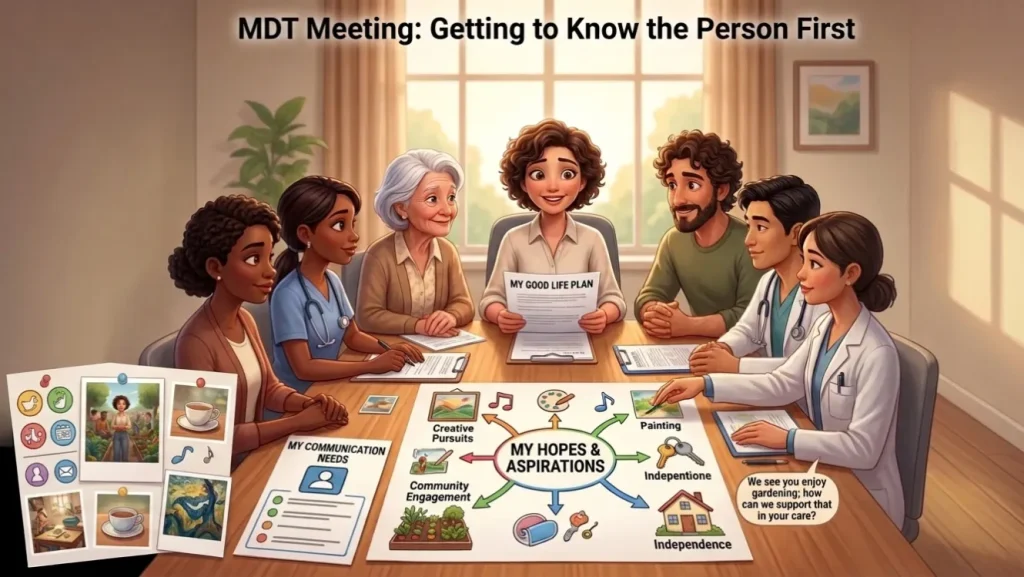
An MDT meeting usually brings together the professionals involved in the person’s care, such as clinicians, therapists, social workers, commissioners, care providers, housing partners, advocates and family members or carers where appropriate. The meeting may cover the person’s current needs, risks, medication, behaviour support, discharge planning, home environment, equipment, crisis planning and follow-up arrangements. Families should expect clear communication, agreed actions, named responsibilities, and space to ask questions, especially about what will happen before, during, and after the transition.
How to Share Concerns and Preferences?
Families and carers can support the MDT by sharing specific, practical information rather than feeling they need to use professional language. This might include what has worked before, what has caused distress, how the person communicates pain or anxiety, what routines matter, what risks worry the family most, and what support they feel able or unable to provide. Concerns should be raised as early and clearly as possible, especially if the family feels the transition plan is unsafe, rushed or missing important details. Good MDT working means these concerns are listened to, recorded, and used to strengthen the plan, rather than dismissed as emotional or separate from clinical decision-making.
How Leaf Complex Care Multidisciplinary Teams Deliver Stabilised Transitions
Leaf Complex Care‘s transitional care team create the conditions for people to come home and stay home. We work with social workers, nurses, occupational therapists, speech and language therapists, psychologists, psychiatrists, PBS practitioners, care managers, support workers, commissioners, safeguarding leads, housing providers, advocates, family members and the person themselves to improve outcomes.
Through our Bridging Support model, specialist teams start early, build trust on the ward, stay close during the move, and continue supporting the person while life in the community begins to settle. Each transition is shaped by the person’s clinical needs, communication, behaviour, housing, relationships, and vision of a good life.
With us:
✓ Relationships and PBS support begin before discharge.
✓ The person’s communication, preferences, routines and quality-of-life goals travel with them.
✓ Risk is anticipated proactively rather than managed only after crisis occurs.
✓ Teams receive modelling, coaching and reflective support, not training alone.
✓ Environments are adapted around the person rather than expecting the person simply to adapt to the service.
✓ Restrictive practices are monitored, reviewed and actively reduced.
✓ Outcomes include quality of life, participation, independence and reduced distress—not incident reduction alone.
✓ Specialist input reduces gradually only when the person and receiving team demonstrate sustainable stability.
Offices: Bristol, the South East, the Midlands, and Somerset.
