

What Are Social Stories?
Social stories are short, simple, visually-explanatory, personalised narratives that explain social situations, events or routines that autistic children, young people and adults can easily understand in a literal way of what is expected. These educational and supportive social narratives were initially developed by Carol Gray in the early 1990s and are widely recognised in autism and learning disabilities practice in the UK and internationally.
Social stories can refer to common everyday scenarios, such as washing hands, making friends, and maintaining personal space, andmight be written to explain:
- Going to the dentist
- Visiting a new place
- School routines or transitions
- Understanding differences in social behaviour
- What to expect in a doctor’s appointment or job interview
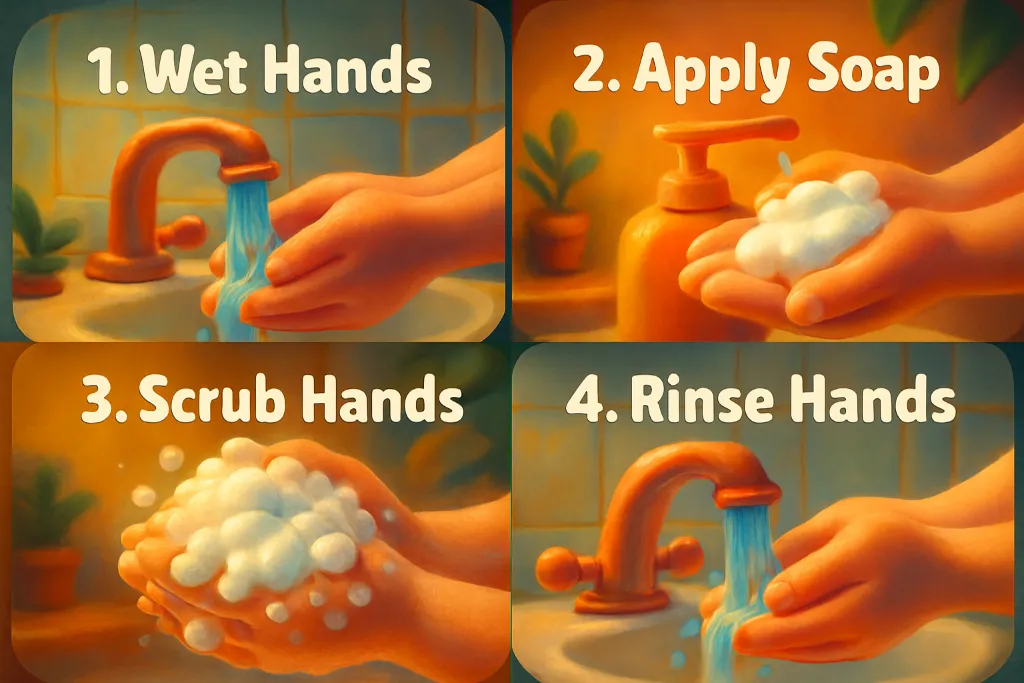
Each story outlines what will happen before, during, and after a given situation, and can be revisited as needed.
Related blog: Social Stories for Autism – When Change Feels Too Big
Purpose of Social Stories for Autism
The purpose of social stories for autism is to support autistic children, young people, and adults in understanding, preparing for, and managing social situations in ways that feel safe, predictable, reassuring, and respectful. Social stories are not about changing who an autistic person is. Their purpose is to increase understanding, reduce uncertainty, and support emotional regulation, especially in situations where social rules are unspoken or confusing.
| Purpose of Social Stories | How do they help/support people: |
| To increase understanding of social situations | – Describe what is happening, who is involved, where it happens, and why – Make hidden social expectations more explicit – Reduce misunderstanding caused by vague or abstract language |
| To reduce anxiety and stress | – Explaining what to expect before, during, and after an event – Preparing the person for changes, transitions, or unfamiliar environments – Offering reassurance through predictability and clarity |
| To support emotional regulation and coping | – Explain feelings that might arise in a situation – Normalise emotional responses (e.g. “It’s okay to feel worried”) – Describe coping strategies or choices available to the person |
| To support communication and social understanding | – Different perspectives in social interactions (without judgment) – How others may think or feel in certain situations – Social outcomes, not as rules, but as explanations |
| To promote independence and confidence | – Navigate everyday situations more independently – Feel more confident in new or challenging environments – Advocate for their needs with clearer self-understanding |
| To provide consistent, compassionate support | – A consistent explanation that can be revisited as often as needed – A non-judgmental alternative to speaking instructions given in stressful moments – A way for families, schools, and care teams to communicate consistently |
Why Predictability is so Important for Autism
Predictability is especially important for autistic people because it reduces uncertainty, supports emotional regulation, and protects mental well-being. Changes are explained, signposted, supported, and the person is given time and tools to adapt. Many autistic children, young people, and adults experience the world as intense, fast-changing, and challenging to interpret. Predictability acts as a stabilising framework that helps them feel safe enough to engage, learn, and thrive. When plans change unexpectedly, autistic people commonly experience distress and anxiety unless changes are clearly communicated and explained. 59% said anxiety has a high impact on their life. Multimedia specialists write social stories and work with support workers and autism-informed care teams to create a more trusting environment for autistic people, helping them understand the change they are about to face, such as uncertainty, transitions and unexpected change.
Intolerance of uncertainty refers to difficulty coping when outcomes, expectations, or situations are unclear. Research shows that autistic people often experience higher levels of IU, and intolerance of uncertainty is strongly linked to anxiety, stress, and emotional overload. Transitions involve ending one state and moving into another, for example:
- Leaving home to go to school
- Switching tasks
- Changes in support workers, rooms, or activities
While unexpected change triggers a stress response because the brain must rapidly reinterpret the environment, previously reliable expectations no longer apply, and sensory and emotional regulation may already be near capacity. The most common reactions may include meltdowns, withdrawal, shutdown, heightened panic and behaviours of distress. Predictability matters at every age:
- Children: supports development, learning, and secure attachment
- Young people: reduces school-based anxiety and Emotionally Based School Avoidance (EBSA)
- Adults: supports independence, employment, healthcare access, and relationships
How Social Stories Prepare The Brain for What’s Coming
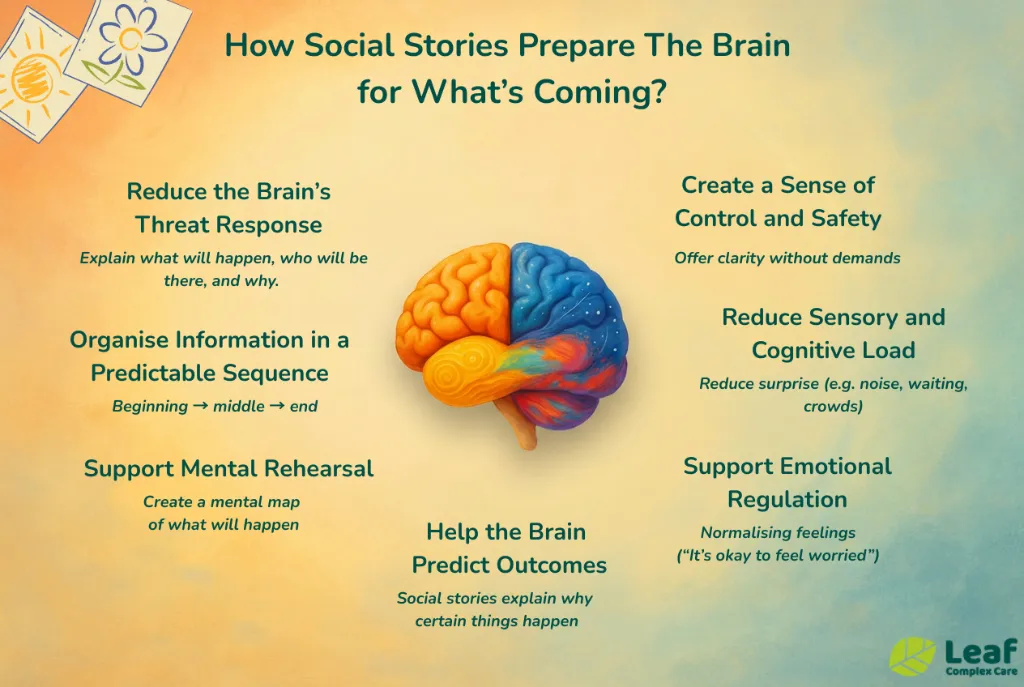
Social stories prepare the brain for what’s coming by reducing uncertainty, organising information in a predictable sequence, and lowering the nervous system’s threat response. For many autistic people, the brain is constantly working to interpret an unpredictable world. Social stories act as a mental rehearsal, allowing the brain to process a situation before it happens, rather than in the moment when stress is higher.
In a neuro-affirming explanation, social stories reduce the brain’s threat response, organise information in a predictable sequence, support mental rehearsals, help the brain predict outcomes, support emotional regulation, reduce sensory and cognitive load, and create a sense of control and safety.
The Psychology of Social Stories
The psychology of social stories lies in helping the brain understand, anticipate, and emotionally prepare for social situations. Social stories work by making implicit social rules and expectations explicit, concrete, and sequential, reducing cognitive load and allowing the brain to process events before they happen. They also support emotional regulation by naming feelings, offering coping strategies, and normalising reactions, creating a sense of safety and predictability. Unlike behavioural tools that enforce compliance, social stories focus on understanding and preparation, respecting neurodivergent processing, while achieving confidence and independence.
Psychologically, social stories engage multiple aspects of learning, emotion, and cognition:
- Cognitive clarity: Reducing ambiguity by explaining what will happen, who will be there and why.
- Predictive learning: Providing structured sequences that the brain can anticipate and rehearse.
- Narrative-based learning: Using storytelling to organise information in a meaningful, memorable way.
- Emotional regulation through understanding: Support awareness of feelings and coping strategies to reduce stress and anxiety.
- Perspective awareness: Gently describing what others might think or feel without judgment.
- Trauma-informed support: Promoting safety, choice, and consistency, lowering stress and supporting management.
How Social Stories Support Emotional Regulation
Social stories help autistic children, young people, and adults manage their emotions by preparing the brain for what to expect and providing a framework to understand experiences. Many autistic people experience intense emotional responses because unexpected events or social situations can feel overwhelming. By explaining situations in a structured, predictable way, social stories reduce uncertainty and help regulate the nervous system’s fear and stress responses.
Normalising Feelings
Social stories communicate that emotions such as worry, frustration, excitement, or disappointment are natural human responses. By showing that these feelings are shared and understandable, the stories reduce self-judgment and shame. This normalisation reassures the person that their reactions are valid, helping them feel more in control and less anxious when facing challenging or unfamiliar situations.
Naming Emotions and Experiences
Many autistic people benefit from having their emotions and experiences put into words, as this can help them identify and process internal states. Social stories label feelings (e.g., “You may feel nervous waiting in line”) and describe experiences step by step. This clarity allows the person to recognise their emotions, plan how to respond, and communicate their needs effectively, thereby strengthening self-awareness and emotional literacy.
Reducing Fear Responses
Fear and anxiety often arise when events are unpredictable or poorly understood. Social stories reduce these responses by providing a clear, predictable roadmap of what will happen, who will be present, and the expected outcomes. This decreases anticipatory stress and helps the nervous system remain calm, allowing the person to engage more confidently rather than react defensively or with distress.
When Social Stories Are Most Effective
Social stories are most effective when they are written proactively, personalised to the individual, and grounded in understanding rather than behaviour correction. Their effectiveness comes from preparing the brain before stress escalates, not from trying to manage emotions in the moment. Well-written social stories use clear, respectful language, focus on what will happen and why, and validate emotional responses rather than directing behaviour. They work best when introduced in calm moments, revisited consistently, and adapted as the person’s understanding or circumstances change.
Transitions and New Experiences
Social stories are particularly compelling during transitions and new experiences because these moments involve high levels of uncertainty and cognitive demand. For autistic individuals, moving from one activity, environment, or expectation to another can feel abrupt and destabilising. A social story prepares the brain by clearly outlining what will happen before, during, and after the transition, allowing time for mental rehearsal and emotional adjustment. This predictability reduces anticipatory anxiety and helps the nervous system remain regulated. By explaining why a transition is happening and what stays the same as well as what changes, social stories provide a sense of continuity and safety, making transitions feel manageable rather than threatening.
Medical Appointments
Medical settings are often overwhelming due to unfamiliar environments, sensory input, loss of control, and fear of the unknown. Social stories are highly effective here because they restore predictability and agency. A well-written social story explains the purpose of the appointment, what the space may look and sound like, who will be present, and what choices or supports are available. This reduces fear responses by helping the individual understand that procedures are planned, time-limited, and intended to help them. Importantly, social stories can also validate anxiety and explain coping options, which supports trust and reduces the likelihood of distress or avoidance during healthcare interactions.

Social Situations
Social interactions can be complex and exhausting due to unspoken rules and rapid social interpretation. Social stories are effective because they make implicit social information explicit without judgment or pressure. They explain what may happen in a social situation, how others might behave, and why specific responses occur, helping reduce confusion and anxiety. Rather than telling the individual how to act, compelling social stories focus on understanding the situation and possible outcomes. This approach supports emotional regulation, reduces fear of social mistakes, and allows the person to engage at their own pace without feeling forced to mask or conform.
School Routines
In educational settings, social stories are most effective when used to support predictability, consistency, and emotional safety. School environments involve frequent transitions, changing expectations, and sensory demands, all of which can increase stress. Social stories help by explaining daily routines, changes to timetables, expectations of different spaces, and what support is available. This clarity reduces cognitive overload and allows the learner to focus on participation rather than survival. When written collaboratively and revisited regularly, social stories can also strengthen trust between the learner and adults, improving engagement and reducing anxiety-related avoidance such as EBSA.
Emotional Challenges
Social stories are especially effective for supporting emotional challenges because they help individuals understand their inner experiences rather than feel overwhelmed by them. Stories that name emotions, normalise feelings, and explain why certain emotions arise help reduce shame and self-criticism. They offer reassurance and describe coping strategies. Over time, this builds emotional resilience and self-awareness, encouraging people to navigate complicated feelings with greater confidence.
Social Stories for Anxiety, Not Just Behaviour
Social stories are often misunderstood as tools for managing behaviour, but their actual value lies in supporting anxiety, emotional regulation, and psychological safety. Social stories work best when they address the emotional experience behind the behaviour, helping the person understand what is happening and why, rather than trying to change their behaviour.
Used for anxiety, social stories help by reducing intolerance of uncertainty, one of the strongest predictors of anxiety in autism. They prepare the brain in advance by explaining situations clearly, breaking them into predictable steps, and naming emotions that might arise. This lowers anticipatory anxiety and prevents the nervous system from moving into the fight, flight, or freeze response. When anxiety is reduced, behaviours of distress often decrease naturally and not because the person is complying, but because they feel safer and more in control.
Crucially, anxiety-focused social stories are non-judgmental and non-directive. They avoid “you should” language and instead validate feelings, offer reassurance, and present choices or coping options. This protects self-esteem and reduces shame, particularly for autistic people who have experienced repeated misunderstanding or pressure to mask. When social stories are used to support anxiety, behaviour often improves, because safety, predictability, and understanding come first.
Social Stories as a Science-Backed Support
Social Stories are widely used in autism support and educational settings because they are grounded in psychological principles, predictability, structured information processing, emotional understanding, and narrative learning, and are designed to help people understand social situations, reduce uncertainty, and prepare for change.
Social Stories are backed by positive empirical evidence, particularly for individual goals and behavioural outcomes, though results vary across studies. One of the most extensive UK studies to date evaluating Social Stories is the Autism Spectrum Social Stories in Schools Trial 2 (ASSSIST-2) — a pragmatic cluster randomised controlled trial involving 249 autistic children aged 4–11 across 87 primary schools. This trial was conducted by UK researchers and aimed to assess whether Social Stories improve social, emotional, and mental health outcomes compared with usual care.
Key findings from ASSSIST-2 include:
- Children who received Social Stories met their individual socio-emotional goals more frequently than those in usual care, a statistically significant outcome.
- Economically, Social Stories are low-cost and may slightly reduce educational support costs without reducing quality-adjusted life-years (QALYs).
- Can support individual goals and are well accepted by parents and educators.
Autism Support Through Social Stories with Leaf Complex Care
At Leaf Complex Care, we embrace autism-informed practices that prioritise understanding, predictability, and emotional safety for autistic people. One powerful support tool we use is Social Stories™ – personalised, structured narratives that explain situations, expectations, and emotional experiences in a clear, compassionate way, so that the people we serve can navigate everyday life with increased confidence and dignity.
We provide personalised support in people’s homes and communities throughout the UK. Our in-house therapy team, including Positive Behaviour Support (PBS) practitioners, Occupational Therapists, and Multimedia Specialists, collaborates closely to help each person achieve their unique goals in learning new skills. From developing independence and nurturing relationships to exploring education, work, social skills, and new experiences, we are committed to walking alongside every person on their journey. Please take a moment to see how our Multimedia Specialist, Benjamin Andrews, crafted a visual story for Rylee. This thoughtful tool helps him navigate his day-to-day activities and prepare for tremarkableial journey to his mother’s house for the holidays, making transitions smoother and experiences more predictable.
Our team is committed to working collaboratively with families, case commissioners and social workers to ensure the best care outcomes. We welcome your inquiries and are here to assist with any information you need.
Our offices are located in Bristol, the South East, the Midlands and Somerset.
