

What are Behaviours of Concern?
Behaviours of concern, also known as challenging behaviours, are actions whose intensity, frequency or duration can put a child, young person, or an adult at serious risk of harm and can cause self-harm and harm to others. Neurodivergent people, people with communication difficulties, mental health needs and trauma, dementia and those affected by intellectual disabilities tend to use behaviours of concern as a form of communication.
Each reaction has its own trigger, and most of the behaviours of concern have deep roots in past trauma, people and events that left a mark in their memory. Also, to understand what else may be contributing to the behaviour, it helps to consider the person’s communication and sensory needs, physical and mental health and current environment. Past trauma can play a part, as can pain, changes in routine, sensory overload or a lack of the right support.
If you are interested in how you can alleviate your loved one’s behavioural difficulties, you can download our family resource A Parent’s Guide to Home Support for Autistic Children. The guide includes many specialist-recommended sensory activities and advice to help children and young people engage in fun play, feel more encouraged to learn new skills, and better manage their behaviour with their parents’ support.
As all behaviours are a form of communication, whether stemming from an unmet need or an unspoken emotion, people can become overwhelmed by emotions such as anger, frustration, and confusion, reaching a point where they lose control. These strong emotions can take the form of physical aggression and verbal aggression. The psychological and physical stress that can come from self-injury (actions like head banging, hitting, biting) affects the general well-being and creates new trauma. Unpredictable behaviour is sometimes followed by offensive language (inappropriate social behaviour), which directly reflects the person’s inner turmoil and can affect their social interactions, physical safety, and overall quality of life. The role support workers and PBS practicioners play in these moments is defining, as they can help people of all ages reduce stress through tailored behavioural support.
Read more about what can trigger behaviours of concern and how to minimise them.
What is a Social Story?
Social stories are personalised, child-friendly short stories that help autistic children and young people, those with a learning disability or those with communication difficulties understand what happens in a stressful scenario, what to expect, and how to respond appropriately. These stories are usually short, and the narrative is often followed by pictures or illustrations/illustrations or visual cues that describe the social situation. Social stories are used when starting a new school, going to the doctor’s office, visiting the dentist, going on a holiday to a new place, or going to the grocery store.

The tone should be supportive and respectful, and the short stories should have a clear structure and specific wording. Social stories are descriptive and literal, and they share a perspective. The context and reasons should be relevant to the situation and the person they’re created for, clarifying expectations and reducing the uncertainty of stepping into the unknown that brings anxiety.
Read more about the types of social stories and how they are tailored to the person.
How Can Social Stories Help With Behaviours of Concern?
Social stories can make a difficult situation easier to understand by providing accessible, personalised information about what will happen, who will be there, and what support individuals can ask for. An evidence-based study says social stories can help with specific social goals and behaviours, and the core criterion was agreeing on a socio-emotional goal around which the story would be built. In this trial, 249 autistic children were involved across 87 schools, and teachers reported that children who received social stories alongside their usual support met their individual social and emotional goals more often than children who received usual support alone.
Social stories bring additional benefits in specific behaviours and can:
- Make unfamiliar situations more predictable.
- Reduce uncertainty around routines.
- Create a better understanding of social expectations, everyday situations and new experiences.
- Explain what may happen and why
- Provide safe alternative answers
For example, if someone finds clinic visits distressing because the waiting room is noisy, sometimes crowded, and they are unsure what will happen next, their PBS plan could arrange a quieter place to wait and agree how they can ask for a break. A social story could show them where they’ll wait, who will meet them and how staff will respond if they ask for a break. The story makes the support easier to comprehend, and the team makes sure it’s in place on the day.
Understand the Behaviour Before Writing the Story
To help individuals with specific social and behavioural difficulties, PBS practicioners and multimedia generally first track the behaviour’s origins. Each person has different needs, supports, and behaviours, depending on what type of social story needs to be developed according to the specific situations. Some children and young adults may need support through social stories for sitting down to eat at the table, playing a game with others, or going on holiday. Therefore, before writing the story, analyse what their behaviour might be communicating, identify the triggers, and observe what happens afterwards.
What the Behaviour Might Be Communicating
Start by seeing what happens in the specific situation you need to support. As we already mentioned, everyone’s needs are different, so let’s build on the example of someone suddenly leaving the table during a meal, which has become a repetitive behaviour only when lunch or dinner is served. They may be trying to get away from an overwhelming smell or noise, experiencing pain or physical discomfort, or finding it difficult to ask for a break. They might also be frustrated because earlier attempts to communicate went unnoticed, worried because they’re unsure what will happen next, or seeking someone’s attention, reassurance or company. Listen to the person in the way that works for them and look at what happened before the behaviour and what changed afterwards.
Aside from this specific example, challenging behaviours might communicate:
- need for attention or connection,
- escape from an overwhelming environment
- pain or physical discomfort
- frustration,
- fear or uncertainty,
- difficulty communicating a need
For PBS practitioners, multimedia specialists and support workers, this should be the starting point for creating the right strategies and interventions to manage behaviours of concern.
Look for Triggers
The next stage is to look for patterns in what happens before the person shows signs of distress. In Positive Behaviour Support (PBS), this is called looking for antecedents. Ask the person what they noticed, using their preferred way of communicating, and compare times when the same activity went well. Let’s set poor sleep as a setting event in this example. A request to put on shoes may be manageable most days and feel overwhelming after a poor night’s sleep. It makes the situation harder, while the request is the immediate event to explore.
The possibilities to explore the person and what you learn from it shape what goes in the story and what the team needs to do. If changing support workers is difficult because the person doesn’t know who is coming, the team could share a photo and arrange an introduction in advance. The story could then explain who they’ll meet, when they’ll arrive and which parts of the routine will be familiar.
Let’s explore the possible triggers and what they might look like:
- An unexpected change – The usual support worker is away, and someone unfamiliar arrives without an introduction.
- A sudden increase in noise or activity – A hand dryer starts as the person enters a public toilet, or a dining room becomes crowded and loud.
- An abrupt transition – The person is asked to stop a game they’re enjoying and come to the table without time to finish.
- A hard-to-follow instruction – Several people speak at once, or instructions come too fast for the person to process.
- A communication attempt goes unnoticed – The person signals that they want a break, but the activity continues because their signal wasn’t recognised.
- Pain or discomfort during an activity – Distress starts when the person bites into food, prompting a check for possible tooth or mouth pain.
Look at What Happens Afterwards
Once you’ve looked at what happened before the behaviour, notice what changed immediately afterwards. In an Antecedent–Behaviour–Consequence (ABC) record, the consequence is simply what happened next. Did the activity stop? Did someone come closer or give the person space? Did the surroundings become quieter? Record what you saw and look for patterns across several occasions.
What to look for?
- An activity stops or is paused. – After the person shouts during a group game, the group pauses, and the person takes a break.
- The surroundings change – After the person covers their ears and leaves the dining table, they move to a quieter room and lower their hands.
- Someone offers attention or reassurance – After the person calls out several times, a familiar support worker sits beside them and explains when their transport will arrive.
- The person gets access to something – After the person pushes their plate away, someone offers them a drink, and they reach for it.
- The way support is provided changes – After the person pushes the game pieces away, the support worker shows whose turn it is using a picture card. The person then picks up a piece.
Example: Social Story for Waiting
Let’s explore what to include at each stage when writing the story.
- Describe what usually happens. Explain where the person usually waits, who is with them and when the transport is due. For example, the person usually waits by the front door with a support worker, and their transport is due at 10 am.
- Explain what might change. Describe what happens if the transport is late. For example, the support worker can check for an update and let the person know what they find out, including when the arrival time is still uncertain.
- Show what choices and support are available. Explain how the person can ask for an update using their preferred way of communicating. Include available options, such as listening to music or waiting somewhere quieter. If the person chooses a quieter place, explain how the support worker will let them know when it’s time to leave.
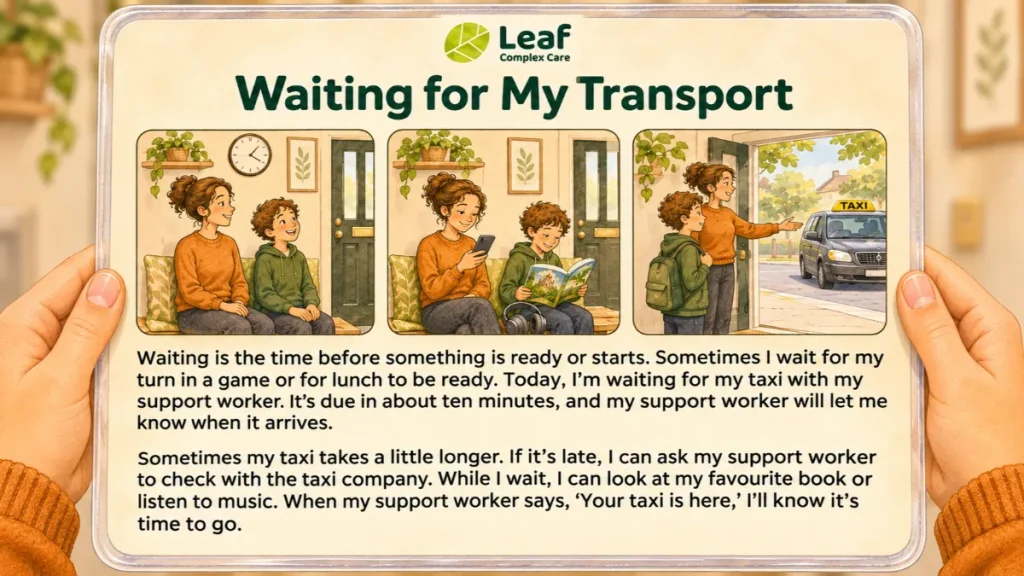
The story written according to the structure should sound like this:
‘Waiting for My Transport’
Waiting is the time before something is ready or starts. Sometimes I wait for my turn in a game or for lunch to be ready. Today, I’m waiting for my taxi with my support worker. It’s due in about ten minutes, and my support worker will let me know when it arrives.
Sometimes my taxi takes a little longer. If it’s late, I can ask my support worker to check with the taxi company. While I wait, I can look at my favourite book or listen to music. When my support worker says, ‘Your taxi is here,’ I’ll know it’s time to go.
How and When to Introduce a Social Story
Give the person time to get to know the social story on their own. That way, when the situation comes up, they have a familiar visual support, as a calming strategy, to return to if they’re unsure what will happen next or how to ask for help.
- Read it when the child is calm. Choose a familiar, unhurried moment when they can look at the story with you.
- During a crisis, focus on the child’s immediate needs. Wait until they’ve had time to recover before introducing the story.
- Revisit it before the relevant situation. Read or look through the story together shortly before the child will need the information, leaving enough time to go at their pace.
- Give the child time to process it. Pause between pages, let them look at the pictures for as long as they need and give them time to respond in their preferred way.
- Keep a copy where the child can access it. This might be a printed copy by the front door or a digital version on their tablet.
Integrating Social Stories into a Broader Behaviour Support Plan
Learning social skills through social stories can become a useful strategy when it becomes part of the broader behaviour support plan, alongside Positive Behaviour Support, supportive language, and coping strategies to build confidence. For example, Waiting for My Transport explains that a taxi can be late and that the child can ask for an update. The support plan records who will check for delays, how they’ll share updates in a way the child understands, and where the child can wait if they’d prefer somewhere quieter, without feeling overwhelmed by loud noise or other stressors that might affect their well-being. It can also explain when to offer the story and where the child can find it again.
Social Stories as Part of Respectful, Person-Centred Support
A respectful social story starts with the person’s perspectives. What would they like to know? Which parts of the situation feel uncertain to them? Involve the person in shaping the story in whatever way works for them, and that way they might choose which photos to include, point out a detail that matters to them or tell you they’d prefer to talk it through. To make social stories person-centred, use language and images they recognise, and give them a choice about when and whether to revisit the story. Respect starts with seeing the situation from the person’s point of view. A personalised social story can be part of creating an inclusive environment, using familiar language and details that matter to the person to help them know what to expect and ease anxiety about what might happen next.
PBS and Multimedia Support with Leaf Complex Care
At Leaf Complex Care, our Positive Behaviour Support (PBS) practitioners and multimedia specialists work with each person to make their support plan easier to understand and use. That might mean creating an animated version of the plan, making a short video story about an upcoming change, or developing visual guides that help support workers follow the agreed approach consistently. The person we support helps shape what goes into these resources and how they’re shared.
When Rylee wanted to surprise his mum at Christmas, he planned the visit with support from our therapy team. Our multimedia specialist created a video story that showed him what to expect on the journey and throughout the day. The story was built around something Rylee wanted to do, and it gave him a way to go through the plan at his own pace before the visit.
You can watch the multimedia story here:
We provide complex support across the UK, with offices in Bristol, the South East and Somerset.
