

A System Under Pressure to Discharge Safely
Delayed discharges are often spoken in operational terms such as ”bed flow” and ”capacity”. They are spoken as if they are not referring to real people or real-life situations. Beneath these words are real lives paused in transition. For people with multiple needs in complex situations, extended stays in hospitals bring increased restrictions, disconnection from familiar relationships, heightened distress rather than alleviated, and overall violation of their human rights. We can all agree that there is already a high risk of harm when people are kept in hospital unnecessarily, especially in long-stay or restrictive settings.
Systems are being asked to move people on more quickly while at the same time being held to high standards of safety, with fewer restrictions, greater accountability, service, and staff quality. And this is the moment where a shared responsibility is required. Safe discharge is not achieved through speed alone, nor through caution that leads to inaction. To ensure a safe hospital discharge, we need coordination, a transition that builds support and confidence, and the right support at the right time.
Within social care, this invites a deeper reflection. What does it truly mean to be ready to leave? And are we, as systems and providers, equally ready to receive?
When “Clinically Ready” Isn’t Enough
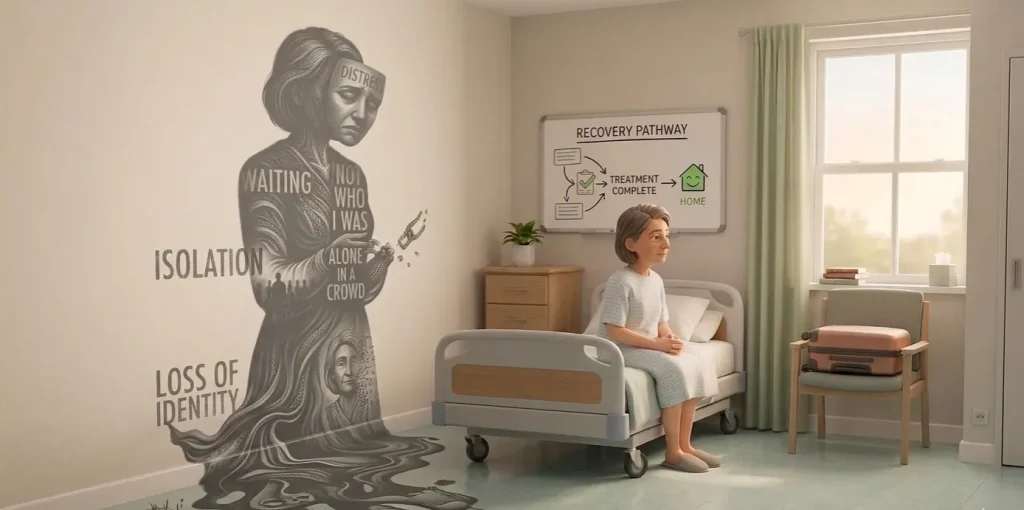
To be declared clinically ready to leave the hospital suggests a moment of resolution, a point at which treatment has done what it can, and the next chapter should begin at home, or in a place that feels like home. Yet, for many people and their families, this moment often marks not an ending, but the start of a different kind of waiting. The chapter implies movement, but the reality is often stillness.
Recent data shows that a significant proportion of people in hospital (particularly autistic people and people with a learning disability) do not require inpatient care, yet remain there due to non-clinical factors. At the same time, many have already spent years in these settings, with around half staying for more than 2 years and some exceeding a decade. Our own findings, drawn from the Catalyst Care Group White Paper 2025, reinforce this wider picture. Based on insights from over 150 respondents, including people and families receiving care, healthcare assistants, social workers, and commissioners, the report highlights a system where progress is evident, yet structural gaps persist.
50% of participants reported not being adequately briefed on their care plan or the discharge process. Poor communication and funding gaps were each cited by 40% of respondents, reflecting ongoing breakdowns among hospital teams, local authorities, and community providers that delay discharge planning. Also, they have identified several recurring issues related to communication, funding, and coordination across services that contribute to delayed hospital discharge. A further 40% highlighted inflexibility around funding bespoke housing solutions, showing that even when a person is ready to leave the hospital, rigid funding frameworks often prevent suitable community placements from being arranged.
As part of our broader family of services, we bring shared expertise and experience in supporting complex transitions. This is reflected in the work delivered by Nurseline Community Services, where structured, therapy-led approaches have enabled Lisa to transition from a long-term hospital setting to stable community living.
Lisa’s New Beginning: From Spending a Decade in a Hospital, to Living in a Place She Can Now Call Home
Who Are Considered “High-Risk Individuals” in Hospital Settings?
Within hospital settings, the term “high-risk” is often used, yet rarely unpacked with the nuance it requires. It can suggest inherent danger or complexity in the person, but in reality, risk is better understood as something that emerges from the interaction between a person and their environment. In many cases, what is labelled as “high-risk” reflects not the person’s needs, but the system’s current capacity to respond to them. Autistic people and people with a learning disability are disproportionately represented within long-stay hospital settings. Many people have experienced extended admissions, repeated placement breakdowns, or cycles of crisis that have led to increasingly restrictive interventions. Over time, this can result in a profile in which behaviours of distress are interpreted primarily through a risk lens, rather than as communication or unmet need.
High-risk situations often include people who:
- Have histories of restraint, seclusion, or overmedication
- Are autistic or with a learning disability
- Have neurological conditions/acquired brain injuries
- Have co-occurring mental health needs, multiple diagnoses, or trauma histories
- Experience significant barriers in communication, leading to unmet needs escalating into distress
- Have lost independence and daily living skills due to long-term institutional care
In such settings, behaviours often escalate, not because they are inherent, but because they are shaped by restriction, uncertainty, and lack of autonomy. Over time, this can reinforce a cycle in which increased distress leads to greater restriction, further embedding the perception of risk. Across the sector, past inquiries such as the Winterbourne View scandal and Whorlton Hall abuse scandal have highlighted the consequences of this cycle when left unchallenged.
In this context, identifying someone as “high-risk” should not limit opportunity or delay discharge. Instead, it should act as a prompt for a more skilled, responsive, and person-centred approach – one that recognises complexity not as a reason to remain in hospital, but as a call to design better support within the community.
The High Risks of Prolonged Hospital Stays
Prolonged hospital stays are often perceived as a place of safety – a controlled environment where risk is contained and managed. Yet, over time, this sense of safety can become misleading. Delayed discharge remains one of the most emotionally distressing experiences for people and their families. Nearly two-thirds of respondents (64%) said discharge was delayed, and the consequences were severe, experiencing:
- Anxiety (*61.5%)
- Stress and depression because of the escalation of behaviours in restrictive environments (*38.5%)
- Depression (*38.5%)
- Loss of trust in professionals (*38.5%)
- Trauma and breakdown of family relationships (*30.8%)
- Isolation (*23.1%)
Each person who has been held clinically unnecessary has reported feeling institutionally dependent and has experienced overmedication and loss of identity.
*Catalyst Care Group White Paper Publication 2025 Data
Policy and Legal Framework: Why This Must Change
The move from hospital to community is underpinned by clear legal duties and national commitments, making unnecessary hospital stays increasingly difficult to justify.
- The Care Act 2014 places a statutory duty on local authorities to promote wellbeing, independence, and inclusion. Prolonged hospital stays, particularly where individuals are ready to leave, sit in tension with this duty, limiting opportunities for autonomy, daily choice, and meaningful community life.
- Under the Mental Health Act 1983, detention must be both necessary and proportionate. However, our findings from the Catalyst Care Group White Paper 2025 highlight a significant concern: only half of respondents reported being informed of their rights under the Act, while the rest had limited or no understanding of those rights. At such a critical point in a person’s care journey, this gap in rights awareness raises important questions about transparency, advocacy, and empowerment.
- The Community Care (Delayed Discharges etc.) Act 2003 further reinforces this responsibility, placing duties on health and social care bodies to ensure that discharge planning is timely, coordinated, and not obstructed by system delays. It reflects a clear principle: hospital care should not extend beyond what is clinically required where community-based support can be arranged.
- The Human Rights Act 1998 further strengthens this foundation by embedding the rights to liberty, dignity, and family life. Extended or avoidable hospitalisation may therefore raise not only practical concerns, but also ethical and rights-based implications.
Alongside this national policy direction, the national plan and action, such as “Building the Right Support“, sets out a clear shift away from institutional models of care towards person-centred, community-based support for people with a learning disability, autistic people, and those with multiple needs. Importantly, it also drives expectations for hospital discharge planning to begin early, be multi-agency, and be outcome-focused, ensuring that people are not left in inpatient settings simply due to gaps in provision. The plan reinforces the principle that care should be delivered in the least restrictive environment, with an emphasis on independence, inclusion, and continuity of support within the community.
If you want to understand how you can take part in and benefit from the Acts, you can now download our overviews of the Acts mentioned above and many more. This is how knowing our rights can change lives.
Bridging Support Model of Care
The Bridging Support Model of Care is a specialist, transition-focused model designed to safely move people from hospital to community settings. It is built for situations where standard pathways are insufficient, particularly when risk, history, and complexity require a more intensive and coordinated response.
We have internal transition teams that don’t step back from complexity. They are built for it, and are actively supporting people who:
- Have experienced multiple placement breakdowns
- Have been considered “too complex”
- Have long histories of hospitalisation or restrictive care environments
Our internal transition teams work closely with clinical and support partners to ensure consistency, safety, and continuity throughout the process. This allows us to remain involved from early planning in the hospital through to full community integration.
Our approach is grounded in:
- Behavioural expertise
- Structured risk management, not risk avoidance
- Human-centred approaches in supporting people safely within community settings
This ensures that risk is understood, planned for, and actively reduced through skilled support rather than exclusion or prolonged hospitalisation.
Where others see risk as a barrier, we see it as a responsibility to design the right support.
From Hospital to Home: What “Permanent” Really Means
The smell of home is grounding. It tells your body, without explanation, that you are safe, that you belong, that you can finally exhale. It reconnects people to identity, routine, and comfort in ways that clinical environments cannot replicate. For someone leaving a long hospital stay, the sensory shift alone can begin to restore a sense of self. It is part of what makes a space feel personal rather than managed, chosen rather than assigned. And in that subtle, almost invisible way, it becomes part of healing through familiarity, dignity, and the quiet reassurance of being somewhere that feels like your own.
However, the home must be appropriate to truly work, by being adapted around the person, not the other way around. Whether through thoughtful design, assistive technology, or location within a community, the right environment becomes a foundation for stability. Without it, discharge risks becoming temporary rather than sustainable. Beyond the physical space, permanence is shaped by what happens next: meaningful living. This includes opportunities to build daily routines, develop skills, access education or employment, and form genuine relationships.

Stable housing, continuity of support, and community-based care reduce readmissions and improve quality of life. But perhaps more importantly, they restore something less measurable: the sense of belonging.
A New Standard of Care: Partnering for Safe, Permanent Discharges
For many care professionals, improving the lives and changing the story of people with multiple needs in complex situations has been a long-standing commitment shaped by real-world experiences, the voices of families, and a strong belief in better outcomes. Central to this is the calling to support people in leaving the hospital and building lives that reflect who they are and what they value, not just the support they require. Yet too often, discharge is treated as a single event rather than an ongoing, carefully managed transition, leaving people to navigate systems that do not fully connect with or respond to their needs.
The new standard of care is here, and it calls for genuine partnership, a purposeful collaboration between commissioners, clinical teams, care providers, housing partners and families. At Leaf Complex Care, we focus on rights-based, person-led support, confidence in decision-making, innovative thinking, and a deep respect for lived experience. Because while systems deliberate, people wait, and time in hospital is time lost. Safe, permanent discharge depends on building robust community support, investing in skilled and confident teams, and creating environments where people can stabilise and grow. And that is exactly what our model of care does.
When we first met Rylee, he had spent a long time in the hospital and was eager for a new chapter in his life. With the right support in place, Rylee moved into Cherry Tree (Leaf’s private accommodation in the Midlands), where he now calls home.
If you want to learn more about our support, internal transition teams, and housing options, please contact us today.
Moving the Most Complex Cases Forward Safely
Supporting people with multiple needs in high-risk situations to move safely from hospital to the community requires a structured, relational approach that begins early and remains consistent throughout the discharge journey. Our model is built around four interconnected phases: Ward, In-Reach, Transition, and Discharge & Stabilisation.
As an Autism-accredited provider, we bring specialist understanding to complex presentations, supported by Rapid Response teams and our internal multidisciplinary team of therapists who can stabilise high-risk situations quickly and effectively. We also have access to a range of housing options, including adapted bungalows and community properties, through trusted housing partners, so we can provide timely, appropriate placements when needed.
While we are open to engaging with regional commissioning teams, the greatest impact is achieved when we are introduced at the earliest stage of discharge planning, allowing us to work in parallel with the system from the outset and prevent delays from arising. We also have immediate skilled support teams ready to go.
If this is what you are looking for in a provider, we would welcome a conversation about how we can support you in creating the right conditions for people to move forward and remain in their communities.
Useful Links:
